


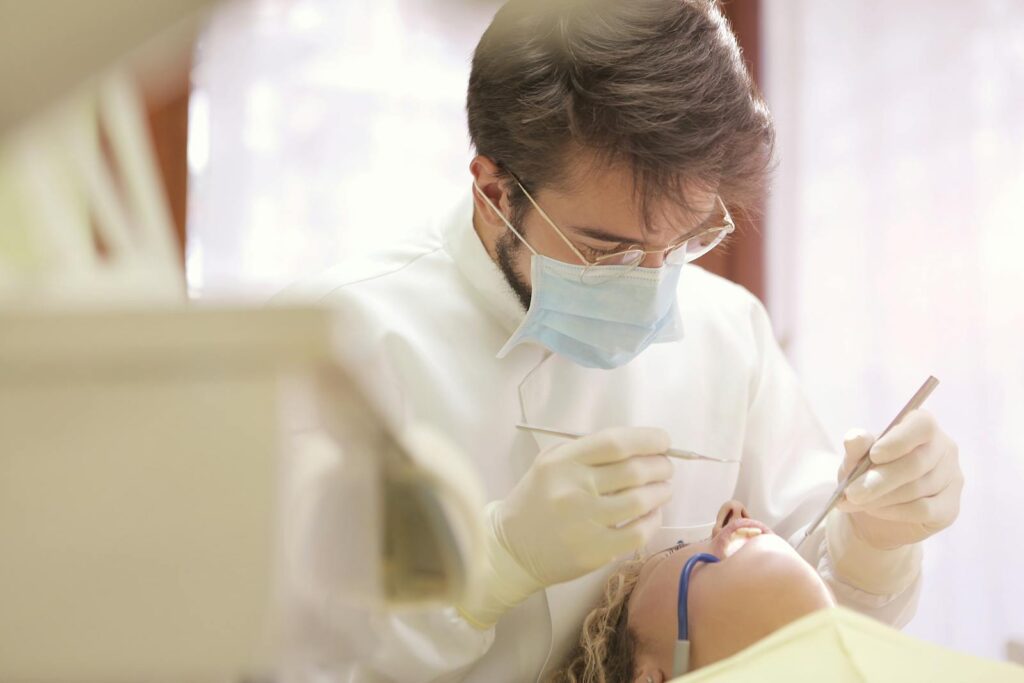
Teeth whitening is one of the most requested cosmetic treatments in Jeddah, but the choice between in-clinic laser whitening and take-home custom trays confuses most patients. The right answer is not “which one is better” — it is “which one is right for your specific case” — and the difference between the two methods is deeper than the marketing suggests.
This guide from the team at cosmetic dentistry at AQUA Dent Clinics, Jeddah explains: the scientific difference between the two methods, the expected results in numbers, the real cost, the actual side effects (not the marketing version), and when you should not whiten your teeth at all.
Reading time: 10 minutes · By the AQUA Dent team · May 2026
How Does Whitening Actually Work?
All forms of professional whitening — in-clinic or at home — rely on the same active ingredient: hydrogen peroxide (H2O2) or carbamide peroxide, which breaks down in the mouth into hydrogen peroxide. The only differences are:
- Concentration: the clinic uses 25 to 40%, the at-home gel uses 6 to 10%.
- Duration: the clinic delivers 30 to 60 minutes in a single session, the at-home protocol uses 30 to 60 minutes daily for 2 to 3 weeks.
- Supervision: the clinic is performed under direct dentist supervision; the at-home protocol is your responsibility after we deliver custom-fitted trays.
The active ingredient penetrates the enamel layer and reacts chemically with the molecules responsible for color inside the dentin, breaking them down and releasing them. This reaction is permanent — but teeth pick up new staining over time, which is why touch-ups are needed.
Laser Whitening — The Truth Behind the Name
First, an important clarification: “laser whitening” is a marketing label. The laser itself does not whiten teeth — it only accelerates the hydrogen peroxide reaction (the way heat speeds up any chemical reaction). What is commonly called “ZOOM whitening,” “Beyond,” or “Pola Office” typically uses an LED light or a specific spectrum light — not a laser in the strict sense.
How an in-clinic whitening session is performed:
- Cleaning and polishing the teeth (15 minutes).
- Gum isolation with a plastic barrier that protects the gums from the gel (10 minutes).
- Application of 25 to 40% hydrogen peroxide gel on the front teeth (outer surface only).
- Activation by light/laser for 15 to 20 minutes.
- Reapplication of the gel 2 to 3 times (60 to 90 minutes total).
- Application of fluoride or desensitizing agents at the end.
Custom Take-Home Trays — How They Actually Work
Professional take-home trays are completely different from over-the-counter “whitening strips” or “whitening pens.” The key differences:
- Trays custom-made for your teeth: fabricated in the lab from an impression or 3D iTero scan of your arches — they cover every tooth precisely and prevent gel leakage onto the gums.
- Moderate concentration: 6 to 10% carbamide peroxide (equivalent to 2 to 3.5% hydrogen peroxide) — designed to be safe for unsupervised home use.
- Wear time: 30 to 60 minutes daily (or overnight), for 2 to 3 weeks to achieve the full result.
When take-home trays beat the clinic:
- If you want full control over how white you go (you stop when you are happy with the result).
- If you have tooth sensitivity — the lower concentration plus gradual application reduces sensitivity dramatically.
- If you want a lower price — take-home trays cost 40 to 60% less than an in-clinic session.
- If you want maintenance after whitening — the same trays can be reused (monthly, for example) to maintain the result.
Real Numbers — A Side-by-Side Comparison
| Criterion | In-Clinic Whitening (ZOOM/Beyond) | Professional Take-Home Trays |
|---|---|---|
| Number of shades brightened | 4 to 8 shades (Vita scale) | 3 to 7 shades (Vita scale) |
| Total session duration | 60 to 90 minutes in a single session | 30 to 60 minutes daily × 14 to 21 days |
| Speed of visible result | Immediate — you see it in the mirror after the session | Gradual — you notice improvement after 5 to 7 days |
| How long the result lasts | 6 to 18 months (depending on diet) | 12 to 24 months (gradual application gives a longer-lasting result) |
| Cost in Jeddah 2026 | SAR 1,200 to 1,990 per session | SAR 800 to 1,200 for trays plus gel |
| Expected sensitivity level | High (40 to 60% of patients) | Low to moderate (15 to 25%) |
| Best for complex cases | Heavy staining, ex-smokers | Mild staining, maintenance, sensitive teeth |
Tooth Sensitivity — What the Marketing Does Not Tell You
40 to 60% of in-clinic whitening patients experience temporary tooth sensitivity for 24 to 72 hours after the session. The sensitivity ranges from mild (cold sensation when drinking cold water) to severe (sharp throbbing pain in the teeth when consuming anything cold or sweet).
Why sensitivity happens:
- The high concentration allows hydrogen peroxide to penetrate the enamel and reach the nerve temporarily.
- Heat from the activating light irritates the nerve.
- If you have small enamel cracks or older fillings, the sensitivity is more intense.
How we minimize sensitivity at AQUA Dent Clinics:
- Application of potassium nitrate or NovaMin before and after the session.
- A prescribed desensitizing toothpaste (Sensodyne Pronamel) used weekly before the session.
- Splitting the session into two appointments instead of one long visit for those who anticipate severe sensitivity.
When You Should Not Whiten Your Teeth
An honest answer: in 6 specific scenarios, we recommend against whitening:
- You have fillings, veneers, or crowns on your front teeth: Whitening does not change the color of fillings or veneers — it only whitens natural enamel. Result: an embarrassing color mismatch.
- Your teeth are stained from tetracycline (an old antibiotic): These stains are within the dentin, and surface whitening cannot improve them adequately. The right answer is veneers.
- You have untreated decay: Whitening penetrates active decay and causes severe pain. Decay must be treated first.
- You have severe gum recession: Exposed root surfaces do not whiten (no enamel) and are extremely sensitive to peroxide.
- You are pregnant or breastfeeding: Not because it is necessarily harmful, but because there is insufficient research to confirm safety. We wait until after weaning.
- You are under 16: The pulp in permanent teeth has not finished maturing, and whitening causes severe sensitivity.
How to Make the Result Last Longer
The most common question we get after whitening: “How long will it last?” The answer depends on your habits. The biggest enemies of white teeth:
- Coffee, tea, and Nescafe (especially without a straw).
- Smoking, shisha, and vape (the worst — they re-stain teeth within weeks).
- Hibiscus and red juices.
- Curry and dark sauces.
- Red wine (for the audience that consumes it).
Our team’s tips for maintaining the result:
- Drink coffee and tea through a straw to avoid contact with the front teeth.
- Rinse your mouth with water immediately after eating or drinking pigmented items.
- Use a whitening toothpaste (with a moderate peroxide content) once or twice a week.
- A maintenance session with take-home trays every 6 months (just 30 minutes) refreshes the brightness.
- Professional cleaning at the dentist every 6 months.
Teeth Whitening Cost in Jeddah 2026 — Comprehensive Pricing
Pricing at AQUA Dent Clinics, Jeddah (May 2026):
- First consultation and shade diagnosis: often waived.
- Pre-whitening cleaning and polish: SAR 350.
- In-clinic whitening (ZOOM/Beyond) — single session: SAR 1,200 to 1,990.
- Custom take-home trays plus gel: SAR 800 to 1,200.
- Touch-up session after 6 to 12 months: SAR 700.
- Full package (cleaning + in-clinic + maintenance trays): SAR 2,800 to 3,800.
Note: these are the prices for medical, professional services performed by certified dentists — they are not salon discounts. Whitening outside the supervision of a dentist carries real risks (gum burns, chronic sensitivity, enamel erosion).
Frequently Asked Questions
Does whitening damage tooth enamel?
Professional whitening does not damage enamel when used correctly. Clinical studies spanning 30 years (since 1989) confirm its safety. However, repeated whitening without rest periods, or using unapproved commercial concentrations, can cause temporary surface mineral loss.
Are home remedies like activated charcoal or apple cider vinegar effective?
Honest answer: no, and they may be harmful. Activated charcoal is a strong abrasive that gradually wears away enamel. Apple cider vinegar is highly acidic and erodes enamel. Both produce a temporary appearance of brightness, but at the cost of enamel health.
Does whitening change the color of crowns and veneers?
No. Porcelain crowns and veneers do not respond to whitening. If you have front crowns, whitening will make your natural teeth whiter than the crowns — creating a mismatch. The solution: either skip whitening, or whiten and then redo the crowns to match the new shade.
How often can I repeat whitening?
In-clinic whitening should not be repeated more often than once every 12 to 18 months. Take-home maintenance trays (monthly, just 30 minutes) are safe long-term. Repeated whitening without rest causes loss of enamel translucency (teeth start to look “dead” visually).
Does insurance cover whitening?
No — whitening is a purely cosmetic procedure and is not covered by any Saudi or international insurance plan. AQUA Dent Clinics does not bill insurance directly — all whitening payments are cash or card (we accept up to 12-month installments via MyFatoorah).
The Next Step
If you are considering teeth whitening in Jeddah, the first step is a diagnostic consultation. In 30 minutes, we assess your current shade on the Vita scale, determine whether whitening is appropriate for you (or whether you actually need a different treatment such as veneers), and recommend the right protocol: in-clinic, take-home trays, or a combination.
To book:
- WhatsApp: +966 920 035 788
- Phone: 920035788
- Book online
Or learn more about cosmetic dentistry at AQUA Dent Clinics.
About the author: This article is written by the cosmetic dentistry team at AQUA Dent Clinics, Jeddah, led by Dr. Jamil Aref — Cosmetic Specialist, UCLA graduate. The article does not replace personal consultation.