

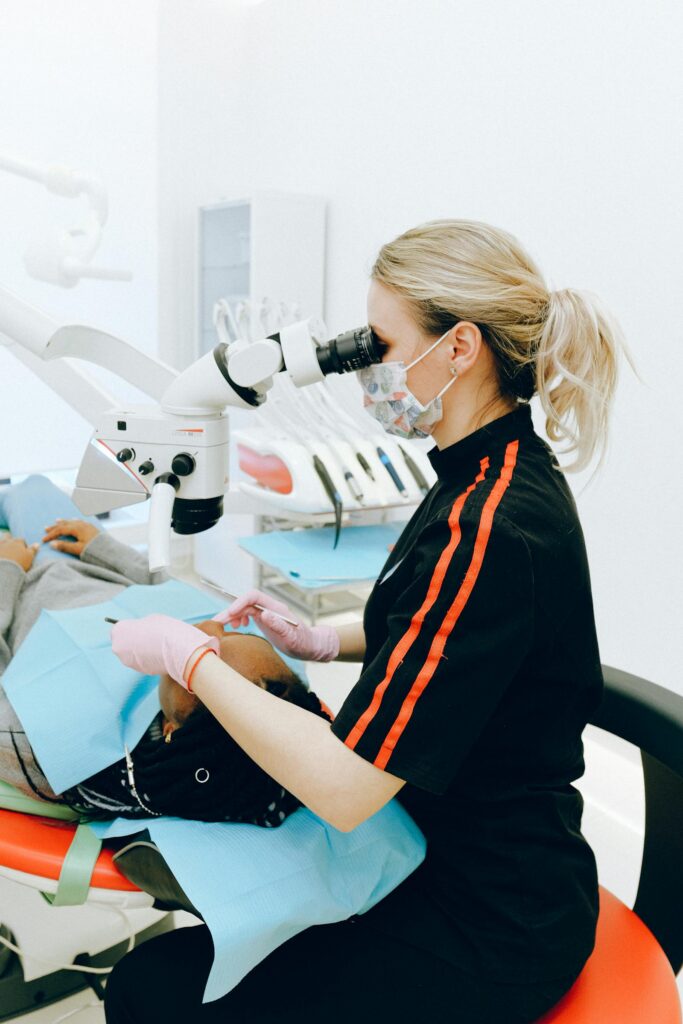
The question I get almost every week: “When do I start orthodontics for my child?” The short answer from the American Association of Orthodontists (AAO) and the American Academy of Pediatric Dentistry (AAPD) is clear: the first orthodontic evaluation should happen at age 7 — even if you think your child’s teeth “look straight.” This does not mean starting orthodontic treatment at age 7 — it means determining whether your child needs early intervention, watchful waiting, or no treatment at all.
I’m Dr. Layla Bamashmous, Orthodontist at AQUA Dent Clinics, Jeddah — board-certified by the American Board of Orthodontics (ABO) and DScD from Boston University, specialized in pediatric and adolescent orthodontics. This guide is for every mother in Jeddah asking: when do I book for my child? What signs warrant immediate intervention? And when is orthodontics a cosmetic option that can be deferred?
Reading time: 14 minutes · By Dr. Layla Bamashmous · May 2026
Why Age 7?
The age 7 recommendation is not arbitrary. At this age:
- The permanent front teeth (incisors) and the first permanent molars erupt.
- The mouth is in a “mixed dentition” stage — primary teeth and permanent teeth side by side.
- The jaw is still in a growth phase — any modification to growth direction is easier and less invasive.
- The most serious orthodontic problems (upper jaw constriction, crossbite, deep bite) are visible and diagnosable.
The first evaluation does not mean placing braces. In 70 to 80% of cases, the diagnosis is: “Everything is normal, see you in a year.” The other 20 to 30% are the children who genuinely benefit from early intervention — and delaying treatment for them can later double the cost and the duration.
The Three Phases of Orthodontics in Children
Phase 1: Early Intervention (Phase 1) — Ages 7 to 10
Also called “interceptive orthodontics” (Interceptive Orthodontics). The goal is not to fully align teeth, but to guide jaw growth and prevent problems from developing. Treatment duration is typically 6 to 18 months, using fixed or removable appliances.
Phase 2: Monitoring (Resting Phase) — Ages 10 to 12
Between Phase 1 and Phase 2, a monitoring period that allows the permanent teeth to erupt fully. Visits every 6 months, no treatment intervention.
Phase 3: Final Orthodontics (Phase 2) — Typically Ages 11 to 14
This is the “traditional orthodontics” everyone knows. In this phase, we definitively align the permanent teeth — either with traditional metal braces, ceramic braces, or Invisalign First for adolescents. Treatment duration is typically 18 to 24 months.
10 Signs to Watch For — Book the Evaluation Immediately if You See Any of Them
- The child constantly breathes through the mouth (especially while sleeping) — may indicate a constricted upper jaw.
- Difficulty chewing or “clicking” in the jaw — may point to a temporomandibular joint problem.
- Reverse bite (lower teeth in front of upper teeth) — an orthodontic emergency; intervention before age 9 prevents jaw surgery later.
- Deep bite (upper teeth covering more than 50% of the lower teeth) — can cause tooth wear and jaw pain.
- Large gap between the front teeth or severe crowding — indicates a mismatch between jaw size and tooth size.
- Early loss of baby teeth (before age 5) or delayed loss (after age 8).
- Thumb or finger sucking after age 5 — changes the shape of the jaw and the position of the teeth.
- Permanent teeth not erupting at the expected time (the front permanent teeth typically erupt by ages 6 to 7).
- The jaw deviates to one side when closing — may indicate a unilateral crossbite.
- Unclear speech (lisp) or difficulty with pronunciation — may relate to jaw or tooth shape.
When Early Intervention Is Genuinely “Necessary” (Not Cosmetic)
The cases that demand intervention at ages 7 to 10 rather than waiting:
1. Maxillary Constriction
If the upper jaw is narrow, the permanent teeth will not have room to erupt. Early intervention with a palatal expander (Palatal Expander) at age 7 to 9 resolves this in 6 months. Delaying treatment past age 12 makes the case much harder and may eventually require jaw surgery.
2. Anterior Crossbite
The lower front teeth close in front of the upper teeth instead of behind them. This harms upper jaw growth and causes wear on the lower teeth. Early intervention resolves the problem in 4 to 8 months.
3. Posterior Crossbite
The back teeth do not close properly, causing the jaw to deviate to one side when closing. Over time, this causes asymmetric jaw growth.
4. Severe Crowding with Lack of Space
If CBCT analysis shows that the remaining permanent teeth will not find space (Crowding > 6 mm), early intervention prevents the need to extract permanent teeth later.
5. Harmful Oral Habits (Oral Habits)
Thumb sucking, tongue thrusting, mouth breathing — all reshape the jaw and cause secondary orthodontic problems. Behavioral intervention plus a moderate appliance at age 6 to 8 corrects this before it becomes a structural deformity.
When to Wait Instead of Starting Immediately
Not every child needs early orthodontics. In the following cases, waiting for the second phase (ages 11 to 14) is better:
- Mild crowding (less than 4 mm) with no functional issues — easily addressed in the second phase.
- Spaces between baby teeth — this is normal and indicates adequate space for the permanent teeth.
- Mild delay in the eruption of one or two teeth — may be normal; we monitor with visits every 6 months.
- Purely cosmetic problems with no functional impact — for instance, a slight tilt of one tooth. Waiting until adolescence is more practical.
Orthodontic Options for Children and Adolescents in Jeddah
1. Traditional Metal Braces
The oldest and most effective for complex cases. Advantages: powerful, treats everything, relatively inexpensive. Disadvantages: visible, requires more oral hygiene effort, the wires can sometimes cause cheek irritation.
Best for: children 8 to 12 in complex cases (severe crowding, crossbite, skeletal differences).
2. Ceramic Braces
Same effectiveness as metal but “more discreet” — uses tooth-colored brackets. Advantages: less visible, similar results. Disadvantages: 30 to 40% more expensive than metal, the plastic ties can stain over time.
Best for: older adolescents (13+) who care about appearance.
3. Invisalign First (for Children 6 to 10)
An Invisalign system designed specifically for children in the mixed dentition stage. Advantages: nearly invisible, removable (the child takes them out for eating and brushing), no weekly visits to tighten wires (visit every 6 to 8 weeks only). Disadvantages: requires the child to wear them 20 to 22 hours daily, more expensive than metal.
Best for: cooperative children ages 7 to 10 in mild-to-moderate cases.
4. Invisalign Teen (for Adolescents 12+)
A version of Invisalign for adolescents, with extra features such as compliance indicators that show whether the child is actually wearing them. Best for: adolescents who dislike the idea of “metal braces.”
5. Removable Orthodontic Appliances (for Specific Cases)
Such as palatal expanders, headgear appliances, and functional appliances. Used for skeletal cases at an early age. Require the child to commit to wearing them for a specified number of hours daily.
Cost of Pediatric Orthodontics in Jeddah 2026
Pricing at AQUA Dent Clinics, Jeddah (May 2026):
- First orthodontic evaluation and diagnosis (CBCT plus 3D iTero scans): often waived.
- Phase 1 — Early intervention: from SAR 8,000 to 14,000 (depending on appliance type and treatment duration).
- Palatal expander — separate cases: from SAR 4,500 to 7,000 (includes the appliance plus 6 months of follow-up).
- Metal braces (Phase 2): from SAR 14,000 to 22,000.
- Ceramic braces (Phase 2): from SAR 18,000 to 26,000.
- Invisalign First (for children 6 to 10): from SAR 22,000 to 30,000.
- Invisalign Teen: from SAR 25,000 to 35,000.
- Retainers after orthodontics: SAR 1,500 (typically included in the Invisalign package).
Installments are available up to 12 months through MyFatoorah for all orthodontic packages.
Frequently Asked Questions from Mothers
Does my child need to see a general dentist first before the orthodontist?
The orthodontic evaluation at age 7 can be with a general dentist (if they have sufficient experience) or directly with an orthodontist consultant. At AQUA Dent Clinics, we perform the evaluation at no cost and recommend whether your child needs orthodontics or not. There is no need for a previous visit — book directly.
Does early orthodontics cause pain for children?
Removable appliances (such as a palatal expander) cause mild pressure for 2 to 3 days after each adjustment, not sharp pain. Children adapt much faster than adults. Full metal braces (Phase 2) are more uncomfortable in the first week and after each tightening, but with regular pain relievers it is easily managed.
How many visits will we make to the clinic during treatment?
- Metal/ceramic braces: every 4 to 6 weeks (total 18 to 24 visits over two years).
- Invisalign: every 6 to 8 weeks (total 12 to 15 visits over two years).
- Phase 1 appliances: every 4 to 6 weeks (total 6 to 12 visits).
Does insurance cover pediatric orthodontics?
Most Saudi private insurance companies (Bupa, Tawuniya, MedGulf) cover part of pediatric orthodontics if it is for medical reasons (and not purely cosmetic). The coverage rate ranges from 30% to 70%. AQUA Dent Clinics does not bill insurance directly — we prepare for you all the medical reports plus the radiographs plus the detailed treatment plan so you can file for reimbursement directly with your insurer.
My son is 8 and his teeth look straight — does he need an evaluation?
Yes, for two reasons: (1) some orthodontic problems are not visible to the naked eye (such as upper jaw constriction or insufficient space for the permanent teeth). (2) Evaluation at age 7 establishes a “baseline” — even if your child does not need treatment now, we monitor jaw growth with visits every 6 months at no extra cost, and we intervene at the optimal moment if any problem emerges.
What is the ideal window to start the final orthodontics (Phase 2)?
Typically 11 to 13 years for girls and 12 to 14 years for boys — after most permanent teeth have erupted but before jaw growth completes. This window gives the best results in the shortest treatment time. Orthodontics at a later age (16+) is still effective, but it takes longer.
The Next Step
If your child is age 7 or older, the first step is the free orthodontic evaluation. The evaluation takes 30 minutes and includes: 3D CBCT imaging, digital iTero impressions, jaw growth assessment, and a written treatment plan (if needed). We email you the full report for at-home review without any pressure.
To book:
- WhatsApp: +966 920 035 788
- Phone: 920035788
- Book online
Or learn more about the orthodontics department at AQUA Dent Clinics — three board-certified orthodontists from the American Board of Orthodontics (ABO), two of whom specialize in pediatric and adolescent orthodontics.
About the author: Dr. Layla Bamashmous — Orthodontist at AQUA Dent Clinics, Jeddah, holds a DScD and CAGS from Boston University, Diplomate of the American Board of Orthodontics (ABO Diplomate, November 2019), Clinical Assistant Professor at Riyadh Elm University. Specialized in pediatric and adolescent orthodontics.