

Authors: Dr. Laila Bamashmous — Orthodontics Consultant, Diplomate of the American Board of Orthodontics, Co-Founder of AQUA Dent Clinics. Dr. Dalia Meisha — Orthodontics & Dentofacial Orthopedics, KAU Associate Professor, ABO Diplomate.
Last updated: May 2026 — based on more than 1,200 orthodontic cases treated at AQUA since 2021, with 2026 Jeddah pricing. For live updated prices, use the AQUA cost calculator.
The 30-second answer
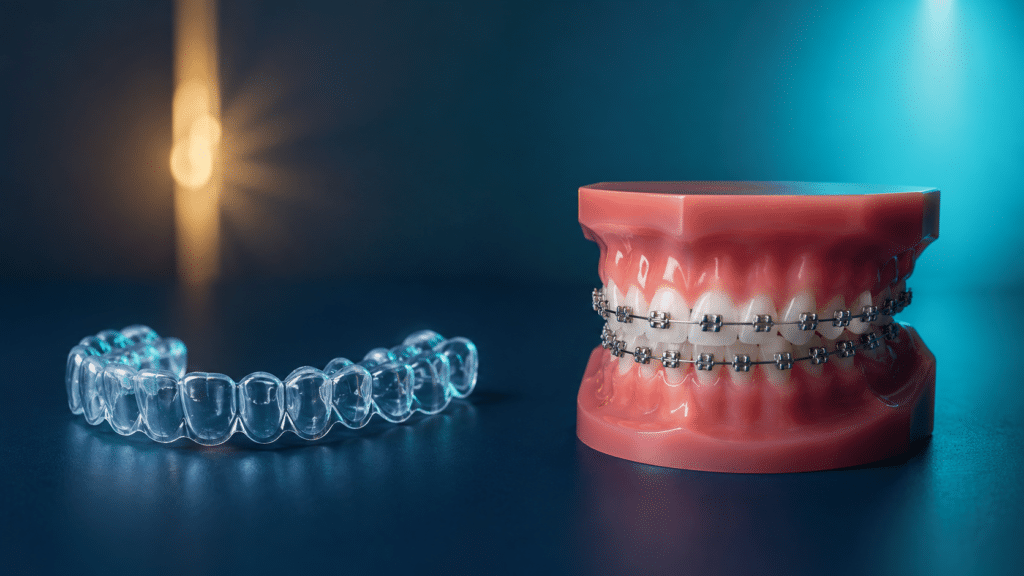
For 80% of orthodontic cases in Jeddah, both Invisalign and traditional braces produce equivalent end results. The decision comes down to:
- Compliance: Will you wear aligners 22 hours/day? If unsure → traditional braces
- Aesthetics: Public-facing job or social anxiety about braces? → Invisalign
- Complexity: Severe malocclusion, jaw misalignment, complex rotations? → Traditional braces (sometimes both at different stages)
- Budget: Invisalign in Jeddah costs ~50% more than equivalent metal braces
- Age: Teenagers under 14 → traditional braces or Invisalign Teen with compliance indicators; adults → Invisalign first choice
Side-by-side comparison (AQUA pricing 2026)
| Option | Cost in Jeddah 2026 (SAR) | Treatment time | Best for |
|---|---|---|---|
| Partial orthodontics (front teeth only) | 10,000 – 12,000 | 6-12 months | Mild front-teeth only |
| Full orthodontics — metal braces (1.5–2 yrs) | 18,000 – 24,000 | 18-24 months | Standard comprehensive case |
| Invisalign Express (3-6 months) | 22,000 – 25,000 | 3-6 months | Very mild crowding only |
| Invisalign Comprehensive | 30,000 – 35,000 | 12-24 months | Most adult cases |
| Lingual braces (behind teeth) | 35,000 – 39,000 | 20-32 months | Maximum invisibility |
| Orthodontics with jaw surgery | 24,000 – 30,000 | 2-3 years | Skeletal cases requiring surgery |
| Phase I children’s orthodontics (ages 7-10) | 8,000 – 14,000 | 9-18 months | Interceptive treatment, jaw growth |
| Retainer (fixed or clear) per arch | 300 – 750 | Lifetime wear | Included in most ortho packages |
For live updated pricing, use the AQUA cost calculator.
Detailed comparison: Invisalign vs braces
| Criteria | Traditional Metal Braces | Invisalign |
|---|---|---|
| Visibility | Highly visible | Almost invisible |
| Removable? | No | Yes (must wear 20-22h/day) |
| Eating restrictions | Many (no sticky/hard foods) | None (remove to eat) |
| Office visits | Every 4-6 weeks | Every 8-12 weeks |
| Best for severe cases | Yes, gold standard | Limited (very severe = traditional) |
| Best for adults | Yes but visible | Yes (most common adult choice) |
| Discomfort level | Moderate (mouth sores possible) | Mild (smooth plastic) |
| Speech impact | 1-2 weeks adaptation | 3-7 days adaptation |
| Risk of staining/decay | Higher (food traps) | Lower (removable for cleaning) |
| Compliance dependency | Low (always on) | HIGH (you can lose results if not worn) |
When traditional braces are the better choice
- Severe crowding (more than 10mm of needed space): Braces with extractions are still the gold standard
- Skeletal jaw issues requiring surgical orthodontics: Pre-surgical alignment is more predictable with braces
- Severe rotations (more than 60°): Brackets give finer control on stubborn rotations
- Children under 13 with mixed dentition: Easier compliance, no lost aligners
- Patients who can’t be relied on for compliance: Honest answer needed — Invisalign requires discipline
- Budget-conscious patients: Quality metal braces start at SAR 18,000 vs Invisalign at SAR 22,000+
When Invisalign wins
- Mild to moderate crowding/spacing: 80% of adult cases fit here
- Mild bite issues (Class II div 1, mild Class III): Modern Invisalign with elastics handles these cases reliably
- Patients with public-facing careers: Newscasters, real estate agents, sales executives, public speakers
- Adults who refuse braces socially: A real factor — patients who’d otherwise skip orthodontics altogether
- Patients with periodontal concerns: Removable for cleaning = better gum health during treatment
- Athletes in contact sports: Lower risk of mouth/lip injury vs. brackets
- Musicians (wind instruments): Less interference with embouchure
The compliance question — be honest with yourself
Invisalign requires 20-22 hours of wear per day. Removed only for eating, drinking anything other than water, and brushing. That’s 2-4 hours of total non-wear time per day.
If you’re someone who:
- Has frequent dinner meetings or coffee meetings
- Snacks throughout the day
- Forgets to put things back where they belong
- Travels frequently and might lose aligners
- Has demanding work where you can’t always brush after meals
… then traditional braces will deliver more reliable results because compliance is removed from the equation. We’ve had patients invest in Invisalign and end up with worse results than they would’ve had with metal braces, because they couldn’t maintain wear time.
Hybrid approach — when we use both
For complex cases at AQUA we sometimes use a hybrid approach:
- Phase 1: Braces (4-6 months): Resolve severe rotations and major skeletal issues
- Phase 2: Invisalign (8-14 months): Fine-tune alignment and aesthetics
Patients get the predictability of braces for hard work and the discretion of aligners for the longer fine-tuning phase.
Treatment timeline at AQUA
- Day 0 — Initial consultation (60 min): Examination, panoramic + cephalometric X-rays, photographs, treatment plan + cost discussion. Free consultation for orthodontic evaluations at AQUA.
- Day 7-14 — Records appointment (90 min): 3D scan with TRIOS, comprehensive photo records
- Day 14-21 — Treatment plan review: See your projected outcome via ClinCheck (Invisalign) or simulation software (braces)
- Day 21-35 — Manufacturing: Aligners shipped from Invisalign US lab; brackets and wires ordered
- Day 35-45 — Treatment start: First aligners delivered or brackets bonded
- Throughout treatment — adjustment visits: Every 6-8 weeks for braces; every 8-12 weeks for Invisalign
- Treatment completion: Removal of brackets or final aligner; impression taken for retainers
- Retention phase — lifetime: Bonded retainer + removable retainer; nighttime wear forever
The retention question — orthodontics’ best-kept secret
The biggest mistake patients make: thinking orthodontic treatment ends when braces come off or the last Invisalign tray is finished. Reality: teeth want to move back to their original position for the rest of your life.
Without retention, 70-80% of patients see noticeable relapse within 5 years. With proper retention (bonded retainer + nightly removable retainer), relapse is under 5%.
At AQUA, every orthodontic case includes:
- A bonded fixed retainer behind the front 6 teeth (upper and lower) — invisible, permanent
- A clear removable retainer for nighttime wear — replace every 2-3 years
- Annual retainer check + replacement guidance
Cost of retention is included in our orthodontic packages — no surprise fees.
Insurance coverage
Most Saudi insurance policies do NOT cover orthodontics for adults — it’s typically classified as cosmetic. For children and teens, coverage is more common. Typical Saudi private insurance plans (Bupa, Tawuniya, MedGulf, MedNet, Allianz) cover:
- 30–50% of adult orthodontics
- 50–80% of children’s and teens’ orthodontics
AQUA does not bill insurance directly. We prepare the documentation (medical report, photos, X-rays, cephalometric tracing, treatment plan) for you to submit to your insurer for reimbursement. Read our full insurance policy here.
Frequently asked questions
Are Invisalign results equivalent to braces?
For 80% of cases — yes. For complex skeletal cases or severe rotations — braces still have an edge. Modern Invisalign (since 2020) handles 90%+ of cases that previously required braces.
Will my speech be affected?
Invisalign: 3-7 days of mild lisp on “s” and “th” sounds, then it normalizes completely. Braces: 1-2 weeks of slight speech adaptation. Both resolve fully.
Can I do Invisalign with veneers or crowns?
Yes. Aligners attach via small composite “attachments” that bond to enamel — they bond to veneers and crowns equally well. We just need to coordinate carefully to avoid damage during attachment removal.
Why is Invisalign more expensive than metal braces?
Each Invisalign aligner is custom-manufactured for your case at Align Technology in the United States — lab fees are the biggest cost. Metal braces use standardized brackets. The convenience and aesthetics premium is meaningful for adult patients.
How do I know if my child needs early orthodontic intervention?
The American Association of Orthodontists recommends an evaluation by age 7. We may not start treatment immediately — but early identification allows us to use growth-modification techniques (Phase I treatment, SAR 8,000–14,000) that are unavailable to adults. See our complete guide to children’s orthodontics in Jeddah (Arabic).
Book an orthodontic consultation at AQUA
The first orthodontic consultation is free at AQUA Dent Clinics — includes examination, professional photographs, and a treatment plan with both options (Invisalign and braces) priced.
- 📞 Phone: 920035788
- 💬 WhatsApp — orthodontic consultation: https://wa.me/966920035788
- 📅 Online booking: aquadentistry.com/en/contact
- 📍 2444 Taha Alkhusayfan Street, Ash Shati, Office 1006, Jeddah 23511
Dr. Laila Bamashmous — Orthodontics Consultant, Diplomate of the American Board of Orthodontics, Co-Founder of AQUA Dent Clinics, more than 14 years of experience.
Dr. Dalia Meisha — Orthodontics & Dentofacial Orthopedics, KAU Associate Professor, Diplomate of the American Board of Orthodontics, published researcher in pediatric orthodontics.
Information for general education only — not medical diagnosis. Every case is unique. Consult a licensed orthodontist before any treatment decision.