

The best dentistry is the least dentistry
Early in my training I was given a sentence that has stayed with me through every cosmetic case I have treated since: “the best dentistry is the least dentistry.” It is a quiet sentence, but it carries a powerful idea — enamel, once removed, never grows back, and every part of the natural tooth we preserve today is one more option we leave open for the patient down the road.
I am a consultant in cosmetic and restorative dentistry. I earned my BDS from King Abdulaziz University and then completed my residency and master’s degree at Nova Southeastern University in Fort Lauderdale, Florida. The Nova restorative program is known for one specific value: the “biological cost” of treatment. Before you plan any procedure, you are asked to justify what you are about to remove from the tooth. That habit never left me. At AQUA Dent Clinics, it has become a core part of how I run a smile consultation — not as a sprint toward veneers, but as a careful conversation about how little we can do and still arrive at a result the patient is genuinely proud of.
No-prep and minimal-prep veneers — when do they work?
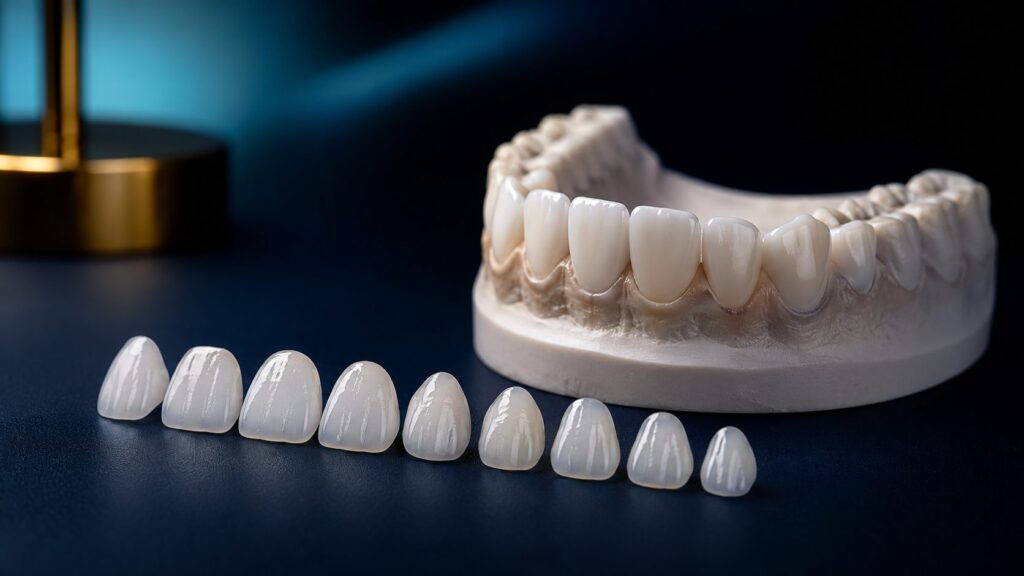
A no-prep veneer is a very thin layer of ceramic — sometimes 0.3 mm or less — bonded to the outer surface of the tooth without removing any real structure. A minimal-prep veneer might involve smoothing a sharp edge or shaping a gentle margin while preserving most of the enamel. When this approach works, it is beautiful in the truest sense: the tooth underneath remains intact, and if the patient’s priorities change in fifteen or twenty years, the option to remove them and start fresh is still on the table.
This approach works when the tooth is already well-positioned, when the patient wants a moderate shade change or a subtle refinement of shape, and when the bite and the smile line cooperate. It does not work on very dark teeth, on teeth that are visibly crowded or rotated, or in cases where a major change in length or alignment is requested. Promising “no-prep” in the wrong case is the number-one reason patients walk out with thick, unnatural veneers that announce themselves from across the room. Sound case selection is the first true act of conservative dentistry.
Composite bonding as a first-line option
Before I reach for ceramics in any form, I ask myself: can direct composite solve this problem? Composite is reversible, repairable, and asks very little of the tooth. A small chip on the edge, a small gap between two front teeth, a worn incisal edge, an asymmetry after orthodontics — all of these can be addressed in a single visit, freehand or with a silicone index from a wax-up, often without any drilling on the tooth at all.
Composite has its limits. It stains more than ceramic over the years, it can chip under heavy occlusal forces, and it depends heavily on the clinician’s experience, eye, and hand in choosing the layers, the shade, and the translucency. But in the right case, it is the most tooth-preserving cosmetic tool we have, and it leaves every future door open. If a composite restoration fails after ten years, we polish it, repair it, or redo it without any further intervention on the tooth itself — and we never find ourselves explaining to a patient why their previously prepared tooth now needs a crown. Personally, I treat every composite bonding visit the way I treat a veneer case: the same planning, the same photographs, the same wax-up, the same time spent on shade selection. The idea is that the patient deserves a conservative restoration that is still made with the spirit of a “cosmetic case,” not a quick cosmetic filling.
Resin infiltration (Icon) and the quiet wins
Some of the most rewarding cases at AQUA never receive a veneer. White spots — those chalky marks that appear after orthodontic treatment or from early demineralization — were once treated either by watching them or by drilling and filling. The Icon resin infiltration technique opens a third path: a low-viscosity resin penetrates the porous enamel, changes its optical behavior, and allows the spot to blend into the surrounding tooth. No drill, no anesthetic, no restoration margin to follow up.
Add a short course of professional whitening, perhaps a small touch of composite on the edges, and the “veneer case” that walked into the clinic suddenly shrinks into something much simpler. This is the kind of result I take the most personal pride in: the patient leaves with a better smile and more natural tooth structure than they walked in with. Many patients are surprised when we present this path; they came in with a single idea in mind — veneers — and they leave having learned that there is an entire ladder of options, and that the bottom of that ladder is sometimes stronger than the top.
When is preparation a real necessity?
Conservatism is not a rigid doctrine. There are cases where real preparation is the honest answer, and pretending otherwise would be a disservice to the patient. Deep tetracycline staining, significant crowding or rotations when the patient does not want orthodontic treatment, large old restorations that have already weakened the tooth, fractures that extend into the dentin — all of these usually require carefully measured enamel preparation, either through a precisely prepared veneer or a full ceramic crown done in a conservative style.
The fundamental difference here is that the decision is made together with the patient, through photographs, a wax-up, and a digital mock-up inside their mouth, with a written alternative plan on the table. Preparation becomes a considered choice, not a default. It is also important to be honest that preparation comes in degrees. Sometimes all we need is to reduce a tenth of a millimeter on the enamel layer alone — and that is still well within the conservative range. Sometimes the situation calls for more. The important thing is that every preparation is recorded with silicone matrices and reduction guides before we begin, so the clinician does not exceed what was actually planned.
The digital mock-up — no irreversible step without a preview
This is a habit I brought home from Nova, and one the AQUA team has refined into a standing protocol. Before we touch a single tooth, we build a digital smile preview. We capture a 3D scan of the mouth and a full set of facial photographs, our laboratory feeds them into our CAD/CAM workflow, the proposed smile shape is designed, and then we transfer that design back into the patient’s mouth as a temporary mock-up they can see, touch, photograph, and live with for a few days.
This preview is the “honest conversation.” It surfaces everything: the length, the line angles, how the lip moves at rest and in a full smile, whether the shade belongs with the skin tone, whether the patient genuinely likes the change they asked for. If something is off, we adjust it on the screen and in the mock-up — not in the tooth. We do not move on to any irreversible step until the patient is truly happy with the preview. In complex cases, our colleagues in prosthodontics and cosmetic dentistry review the plan together — this “internal second opinion” at AQUA has saved more than one patient from a treatment they would have regretted.
Thinking in decades, not appointments
A cosmetic decision made in your thirties needs to live into your sixties and beyond. The more tooth structure we preserve today, the wider the options we leave the patient tomorrow: repair instead of replacement, a new veneer instead of a crown, a crown instead of an implant. Conservative dentistry is not a slogan; it is a long-term strategy for keeping people in their own teeth for as long as biology allows. Every millimeter of enamel we hold on to today is an investment in quality of life decades from now: stronger bonding, less sensitivity, and a lower likelihood of needing root canal therapy or extraction in the future. This is the real meaning of “less is more” in cosmetic dentistry.
What does this look like in the chair?
My cosmetic consultation runs in a fixed order. We listen first, for a long time. We photograph and scan the mouth, and we study the smile at rest, in speech, and in a full laugh. We ask the patient what they want to change, and just as importantly: what they want to keep. Then we propose the least invasive option that can actually deliver the result, and we explain the more invasive options honestly, including what each one costs in enamel.
Sometimes the answer is a whitening session and a single bonding visit. Sometimes it is Icon with a light edge refinement. Sometimes it is four no-prep veneers, sometimes eight minimal-prep veneers, and sometimes it is a fully prepared case because that is what the mouth genuinely needs. The plan is earned, never assumed.
In closing
The most beautiful smile is the one that still looks like you. When a patient leaves AQUA and their friends tell them they look more rested or happier without being able to put their finger on what changed, that is the result I am working toward. Less preparation, more enamel, wider options — and a smile that quietly returns home to its owner.
— Dr. Ahmed Abuzinadah, Consultant in Restorative and Cosmetic Dentistry, AQUA Dent Clinics. Instagram: @aj.abuz