

Parents ask me this question almost every week, and it is one of the most important questions in pediatric dental and orthodontic care. The short answer comes from the American Association of Orthodontists (AAO): a child should see an orthodontist no later than age seven. Most parents hear that number and assume it means braces at seven. It does not. What it means is that by age seven, a child’s permanent first molars and front incisors have usually erupted, and those teeth alone reveal almost everything I need to see about how the jaw is growing, how the bite is developing, and whether any habit or crowding pattern is starting to shape the face in a way we will regret later if it is left alone.
I trained in orthodontics at Boston University, where I earned my Doctor of Science in Dentistry (DScD) and Certificate of Advanced Graduate Study (CAGS) in Orthodontics. I am also Saudi Board certified and serve as a clinical lecturer in the postgraduate program at Riyadh Elm University. A formative part of my training was at Franciscan Children’s Hospital in Boston, where I worked with children whose growth patterns were still unfolding and whose bites were still shapeable. That experience taught me something I repeat in my clinic at AQUA every day: timing in orthodontics is no less important than the technique itself. I can correct a crossbite in a nine-year-old with a small expander in a matter of months. The same crossbite in a sixteen-year-old, after the midpalatal suture has fused, may require jaw surgery. The biology rewards us for paying attention early, and it costs us heavily when we are late.
Why age seven specifically?
By age seven, enough of the permanent dentition has erupted — usually the first molars and the central and lateral incisors — that an orthodontist can read the bite reliably and build an accurate assessment on it. Before that, most of what we see is baby teeth, which tell us very little about how the permanent teeth will look once they settle into their final positions. After age seven, we begin to lose certain therapeutic tools: growth is still active, but correcting some problems becomes harder without appliances that demand more cooperation from an older child. So seven is the sweet spot: early enough to intervene if intervention is needed, and late enough to see the architecture of the jaws clearly.
The AAO has held this recommendation for decades, and the American Board of Orthodontics (ABO) — of which I have been a Diplomate since 2019 — reinforces the same standard. Board certification is not a paperwork exercise; it requires submitting a portfolio of treated cases to a panel of examiners, and one of the things examiners scrutinise is whether the clinician recognised the right moment to start, not just the right mechanics to use.
Early warning signs parents can spot at home
You do not need to wait for a dental visit to notice some of these. If your child is five or six and you see any of the following, book the evaluation now rather than waiting for age seven:
- A crossbite — when a lower tooth sits outside the upper tooth when the child bites down, on one side or both. A unilateral posterior crossbite forces the lower jaw to shift to one side, and if left alone, the jaw can grow asymmetrically.
- Severe crowding — baby teeth touching with no spaces between them almost always predicts crowded permanent teeth, because permanent teeth are larger.
- Thumb sucking or pacifier use past age four or five — prolonged habits reshape the palate and push the upper front teeth forward, producing an open bite.
- Mouth breathing — often linked to enlarged adenoids or allergies, it narrows the upper jaw and changes facial growth patterns.
- Early or late loss of baby teeth — either extreme can signal a problem with eruption or with space.
- Difficulty chewing, or a jaw that clicks or shifts when the child opens and closes.
- Front teeth that do not meet when the back teeth are together (open bite), or upper teeth that cover the lower teeth completely (deep bite).
What happens at the first evaluation?
The first evaluation at AQUA is calm and unhurried, and I make sure the child is comfortable before anything else. I sit down with the child and parent together and explain every step before I do it. The clinical exam itself is short: I look at how the teeth meet, how the jaw moves, the symmetry of the face, and the condition of the soft tissues inside the mouth. If the clinical picture suggests I need more information, I will take a panoramic X-ray to see the unerupted teeth, assess the position of developing roots, and rule out missing, extra, or impacted teeth. Sometimes I also take a lateral cephalometric image to study the relationship between the upper and lower jaws and the angle of facial growth. If the case is clear and there is no problem, we take a few documentation photos, place the child on a routine monitoring schedule, and send you home with no appliance. No treatment. No braces. Just follow-up.
Early evaluation does not mean early treatment
This is the point I want every parent to leave with. In the vast majority of children I evaluate at seven, my recommendation is to do nothing now and see them again in a year. Most orthodontic problems are better treated in one comprehensive phase, when most of the permanent teeth have erupted, usually between ages eleven and thirteen. Early treatment when the biology does not call for it adds cost, more time in appliances, and fatigue for the child — without a better outcome.
When interceptive treatment is genuinely indicated, it is because the problem responds better to intervention now than it will later. The interceptive measures I use most often are:
- Space maintainers — small fixed appliances that hold the space when a baby tooth is lost too early, so the permanent tooth has room to erupt in line.
- Habit appliances — for thumb sucking or tongue thrusting that has not resolved on its own. These are simple appliances worn until the habit stops.
- Palatal expansion — an appliance that widens the upper jaw gradually over several months. It is the single most time-sensitive treatment I perform, because the midpalatal suture is open in children and closed in teenagers. Correcting a narrow upper jaw at nine is a simple matter; at seventeen, it may require surgery.
- Selective guidance of eruption — in some crowding cases, removing specific baby teeth in a planned sequence creates space for permanent teeth to come in more favourably.
What I do not do is treat every child who walks in. Most orthodontists I respect agree that the decision to intervene early should be conservative and supported by a clear biological reason. If someone recommends braces for your six-year-old and cannot explain exactly which problem the braces are solving right now, ask for a second opinion.
A note on clear aligners for children
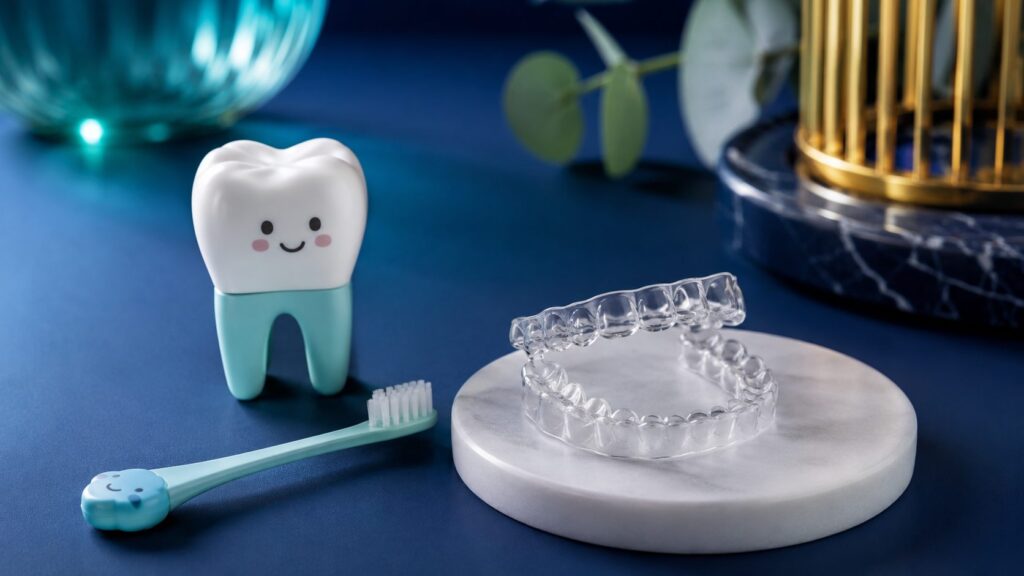
Parents often ask whether their child can skip metal braces and go straight to clear aligners. Aligners can be appropriate for some compliant teenagers, but for young children, fixed appliances are usually more predictable because they do not depend on the child remembering to wear them twenty-two hours a day. I decide case by case, never by marketing.
Book the evaluation
If your child is approaching seven, or if you are already noticing any of the signs above, I would be happy to see you at AQUA. The visit is unhurried, the exam is gentle, and in most cases you will leave with reassurance rather than a treatment plan. Either outcome is a good one — because the cost of looking early in orthodontics is almost nothing, and the cost of looking too late can be significant.
You can book directly with me through the AQUA appointment page, or ask for Dr. Laila Bamashmous when you call. I look forward to meeting your child.