


If you follow me on Instagram (@drhatimaq), you already know I love a good myth-busting reel. The same questions come up in my chair every week, and most of them are built on something a friend said, a video that went viral, or a bad first experience twenty years ago. Cosmetic dentistry has moved a long way since then, and a lot of what people “know” is simply out of date.
Here are the five myths I hear the most, and what the current evidence actually says. I am going to keep this practical and direct, because my job is not to sell you a treatment. My job is to help you make a calm, informed decision about your own smile.
Myth 1: Whitening damages your enamel
This is the big one. Almost every patient who asks about whitening starts with, “But doesn’t it ruin the teeth?” The short answer is no, not when it is done properly under professional supervision.
Professional whitening uses hydrogen peroxide or carbamide peroxide at controlled concentrations. The peroxide molecule is small enough to pass through enamel and break apart the stain molecules trapped in the dentin underneath. It changes the color of the stain. It does not eat away the tooth. Multiple systematic reviews have looked at enamel hardness, roughness, and mineral content before and after supervised whitening, and the changes are either non-existent or fully reversible within days as saliva remineralizes the surface.
What actually causes problems is the unsupervised part. The random gel you bought online at an unknown concentration, the LED mouthpiece you wear for an hour every night, the charcoal powder you scrub with twice a day. These cause three things: dehydration sensitivity, gum irritation from gel leaking out of an ill-fitting tray, and in the case of abrasive powders, actual enamel wear over time. The chemistry of whitening is not the problem. The dose, the frequency, and the lack of a dentist checking your gums and existing restorations are the problem.
If you already have sensitive teeth, a good dentist will lower the concentration, shorten the session, and add a desensitizing agent before and after. If you have fillings or crowns in your front teeth, we will warn you in advance that those restorations will not change color, and we will plan the sequence accordingly — replacing any old filling at least two weeks after whitening ends, so the final shade is stable. That is the difference between safe whitening and whitening that hides surprises in the result.
Myth 2: Veneers ruin your natural teeth
This myth comes from a very specific, very real history. Early porcelain veneers in the 1980s and 1990s often required aggressive reduction, sometimes removing one to two millimeters of enamel. Once you strip a tooth that much, you cannot go back. The patient is committed to restorations for life.
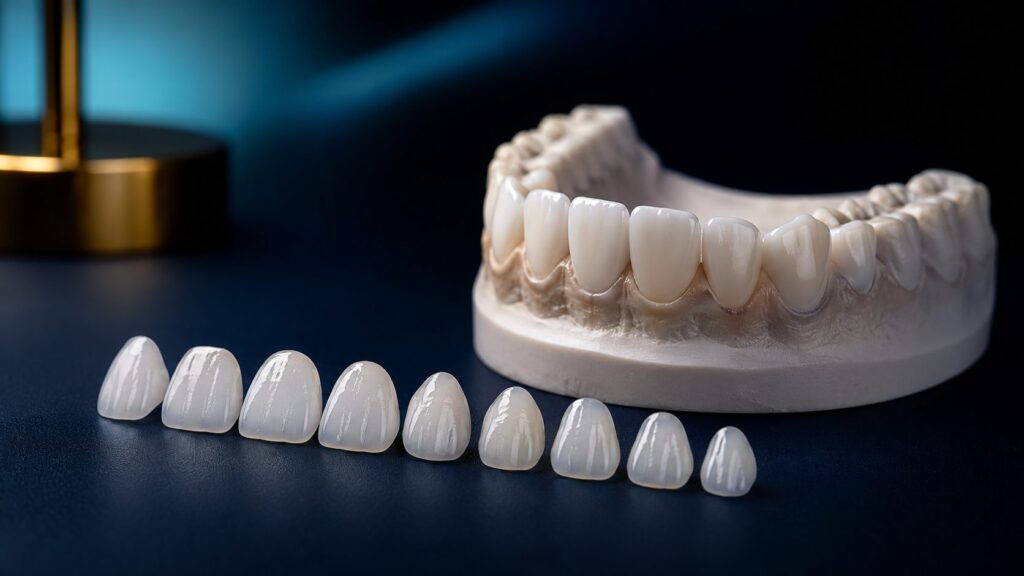
Modern cosmetic dentistry has changed this. With today’s lithium disilicate and feldspathic porcelains, a well-designed veneer can be as thin as 0.3 millimeters. A properly prepared minimal-prep veneer preserves more than 90 percent of the original enamel in most cases. In selected cases, we use no-prep veneers and remove nothing at all. The bond between porcelain and enamel is actually stronger than the bond between porcelain and dentin, so the more enamel we preserve, the longer the veneer lasts and the healthier the tooth stays.
The caveat is real, though: a veneer is only as conservative as the dentist doing it. If a case is planned by eye alone, without a diagnostic wax-up or a digital preview, the preparation often ends up deeper than it needed to be. Ask your dentist, before anything touches your teeth, how many millimeters they plan to remove, whether the case has been planned on a model or scan first, and whether you can see a 3D simulation of the result before they start. Those three questions protect you from finding yourself with a deeper preparation than necessary.
Myth 3: All composite fillings look fake
I hear this from patients who had an old white filling that turned yellow, developed a visible border, or looked flat next to the surrounding tooth. That experience is real, and it is the reason this myth persists.
Two things have changed. The materials have improved enormously. Modern nano-hybrid composites come in layered shade systems with separate dentin, enamel, and translucent increments. And the technique has improved. A well-trained dentist places composite in layers, each one chosen to match a specific optical property of the natural tooth. Dentin shades give the warm core. Enamel shades give the outer translucency. A thin incisal layer gives the subtle blue-grey at the biting edge. When all three come together correctly, the restoration scatters light the same way the surrounding tooth does, and the border genuinely disappears.
I post time-lapse videos of this layering on my Instagram because it is the best way to show why two composite restorations from the same material on neighboring teeth can look completely different. Material is part of the story. Technique is most of it. That is why a well-done anterior cosmetic filling can take up to an hour for a single tooth, compared to ten minutes for a simple posterior filling. Time is the difference between a result that lasts years and one that needs adjustment after a few months.
Myth 4: Once you get veneers, you need them forever
This one has a kernel of truth, and that is why it spreads. If your original preparation removed a lot of enamel, then yes, you are committed to some kind of restoration on that tooth for life. You cannot un-prepare a tooth.
But it depends entirely on how conservative the first preparation was. A minimal-prep or no-prep veneer can be removed and replaced conservatively when the time comes, because the underlying tooth still has most of its enamel. Veneers typically last between 10 and 20 years depending on material, bite, and hygiene, and the replacement process on a well-preserved tooth looks nothing like a major reconstruction. It is a refresh, not a rebuild.
This is why I spend so much time on the planning phase before we touch anything. A conservative first preparation is a gift you give your future self. Ten years from now, when styles change or a veneer chips, you want to have options. Deep preparations take those options away and turn you into a patient who is committed to restoration, instead of a patient who freely chooses the type of restoration.
It is also important to understand that veneers are not a substitute for daily care. Brushing twice a day, flossing, and a regular dental visit every six months — these determine the lifespan of a veneer more than the choice of material sometimes does. Strong habits like nighttime grinding need a night guard, because porcelain fractures usually do not happen from chewing, but from repeated nighttime pressure.
Myth 5: A Hollywood smile is one-size-fits-all
The bright, uniform, extra-white set of veneers you have seen on celebrities is a specific aesthetic choice, not a universal goal. And honestly, it does not suit most faces.
Good smile design starts with the face, not the teeth. We look at lip line, facial midline, tooth proportion relative to the width of your face, how much tooth shows when you speak versus when you smile fully, and the character of the teeth you already have. A slightly rounded edge on a canine, a gentle asymmetry between the two central incisors, a shade that matches the warmth of your skin — these are the details that make a smile look like it belongs to you, rather than like it was installed on you.
Whiter is not always better. A B1 shade that looks stunning on one patient reads as artificial on another. The best cosmetic work is the work nobody notices is work. That is the goal I aim for with every case.
A soft invitation
At AQUA we offer a digital smile preview before any irreversible treatment. We scan your teeth, design the proposed smile on screen, and show you what it would look like on your face before we make a single change. It is the best way to move from “I think I want this” to “I know this is right for me,” and it costs you nothing but an hour of your time.
Follow me on Instagram @drhatimaq for more quick myths, and feel free to send me your questions. If a question keeps coming up, I will turn it into a post.